

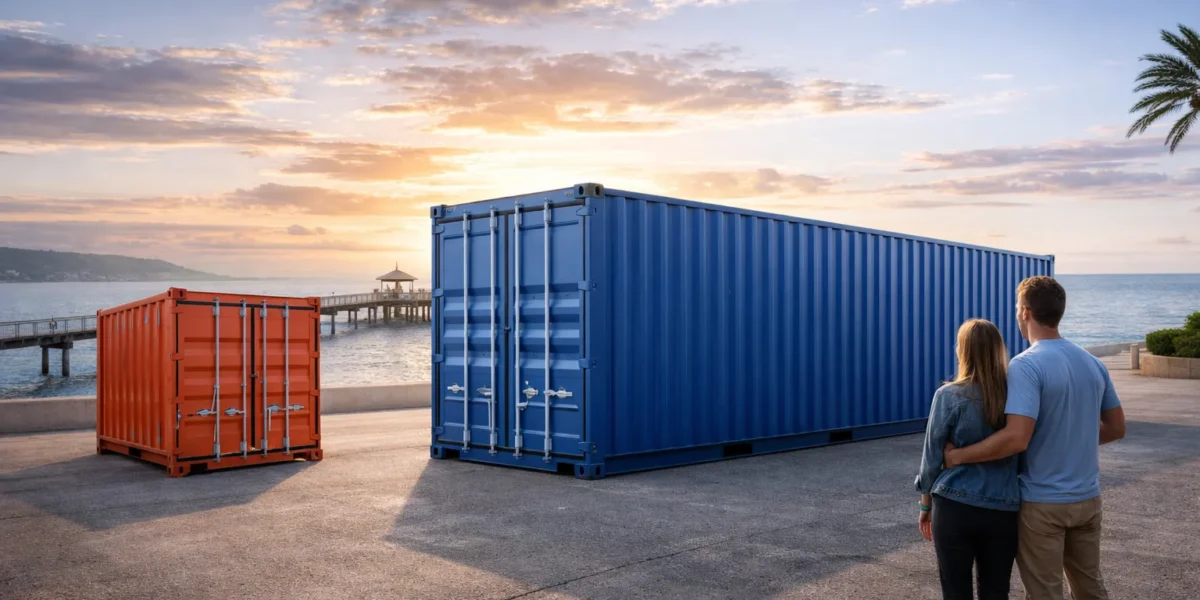
The 20ft and the 40ft are the two most purchased shipping container sizes in the United States. Together, they account for roughly 90 percent of all conex box sales in the country. If you are buying a container in 2026, there is a very high chance you are choosing between these two.
On paper, the decision sounds simple — the 40ft is double the size for not double the price. But in reality, the right choice depends on your property, your access space, your budget, what you are storing, and how you plan to use the container long-term. Plenty of buyers have ordered a 40ft only to realize it does not fit their driveway, and plenty have ordered a 20ft only to realize they need more space six months later.
This guide covers everything you need to know to make the right call the first time.
The Numbers — Dimensions Compared
Here is a direct comparison of the two most common container sizes:
| Specification | 20ft Standard | 40ft Standard | 40ft High Cube |
|---|---|---|---|
| External Length | 20 ft (6.1 m) | 40 ft (12.2 m) | 40 ft (12.2 m) |
| External Width | 8 ft (2.44 m) | 8 ft (2.44 m) | 8 ft (2.44 m) |
| External Height | 8 ft 6 in (2.59 m) | 8 ft 6 in (2.59 m) | 9 ft 6 in (2.90 m) |
| Internal Length | 19 ft 4 in | 39 ft 5 in | 39 ft 5 in |
| Internal Width | 7 ft 8 in | 7 ft 8 in | 7 ft 8 in |
| Internal Height | 7 ft 10 in | 7 ft 10 in | 8 ft 10 in |
| Floor Area | ~150 sq ft | ~320 sq ft | ~320 sq ft |
| Capacity | 33.2 m³ (1,172 cu ft) | 67.7 m³ (2,390 cu ft) | 76.3 m³ (2,694 cu ft) |
| Empty Weight | ~5,070 lbs | ~8,380 lbs | ~8,750 lbs |
| Max Payload | ~48,500 lbs | ~58,860 lbs | ~58,270 lbs |
The key takeaway from these numbers is that a 40ft container gives you more than double the usable volume of a 20ft — not exactly double, because the width and height remain the same while only the length doubles. In practical terms, you get 2.1 times the storage capacity for roughly 1.4 times the price.
Pricing Comparison In 2026
Container pricing varies by condition, location, and supplier, but here are the typical ranges you will find across the USA in 2026:
20ft Conex Box Pricing:
- One Trip (near new): $3,500 – $5,500
- Cargo Worthy: $2,500 – $3,500
- Wind & Watertight: $1,450 – $2,500
- As-Is: $800 – $1,500
40ft Conex Box Pricing:
- One Trip (near new): $4,800 – $6,500
- Cargo Worthy: $3,000 – $4,500
- Wind & Watertight: $1,800 – $3,500
- As-Is: $1,000 – $2,000
The price difference between a used 20ft and a used 40ft is typically only $300 to $1,000 — which means the cost per square foot of storage is dramatically lower with the 40ft. A WWT 20ft at $1,800 works out to about $12 per square foot. A WWT 40ft at $2,400 works out to roughly $7.50 per square foot. If raw storage value is your priority, the 40ft wins every time.
Delivery costs are comparable for both sizes since they ship on the same type of tilt-bed truck, though the 40ft requires more clearance at the delivery site.
When A 20ft Container Is The Right Choice
The 20ft container is the better option in these specific situations:
Limited space or tight access. A 20ft container needs approximately 40 feet of straight clearance for the delivery truck to place it. A 40ft container needs 60 feet or more. If your driveway is short, your yard is narrow, or there are overhanging trees or power lines in the way — a 20ft may be the only size that physically fits.
Residential neighborhoods with HOA or zoning restrictions. Many homeowner associations and local zoning codes are more lenient with smaller containers. A 20ft unit sits lower to the ground, takes up less visual space, and is easier to screen with fencing or landscaping. Some municipalities specifically permit containers under a certain size without requiring a building permit.
Single-purpose storage. If you only need to store a specific set of items — seasonal decorations, lawn equipment, a motorcycle, workshop tools — a 20ft container offers 150 square feet of floor space, which is more than enough for most personal storage needs. Buying a 40ft and leaving half of it empty is wasted money.
Easier to move later. If there is any chance you will relocate the container in the future, a 20ft is significantly easier and cheaper to move. It weighs roughly 5,000 pounds empty compared to 8,400 for a 40ft, and more trucking companies have equipment rated for the smaller unit.
Multiple containers instead of one large one. Some buyers prefer two 20ft containers placed side by side or in an L-shape rather than a single 40ft. This gives you separate lockable compartments for different purposes — one for equipment and one for materials, for example — with more flexible placement options on your property.
Tighter budgets. If your budget is firmly under $2,000, a used 20ft WWT container gets you secure, weatherproof storage at the lowest possible entry price in the market.
When A 40ft Container Is The Right Choice
The 40ft container is the better option in these situations:
Commercial and industrial storage. Businesses need space. A 40ft container holds 2,390 cubic feet of inventory, equipment, or materials. For retail overstock, warehouse overflow, construction tools, or agricultural supplies, the 40ft is the industry standard for a reason.
Container home or office conversion. If you are building a living space, office, or workshop inside a container, the 40ft gives you 320 square feet of floor area — enough for a small studio apartment, a full home office, or a functional workspace with room to move. A 20ft container at 150 square feet feels cramped once you add walls, furniture, and a bathroom.
Vehicle storage. A 20ft container can fit a compact car or a small tractor, but barely. A 40ft container can comfortably hold a full-size truck, two ATVs, a boat, or multiple motorcycles with room to spare for tools and accessories.
Best value per square foot. As shown in the pricing section, the 40ft container offers nearly 65 percent more storage per dollar spent. If your site can accommodate the size and you have the budget, the 40ft is almost always the better financial decision.
Construction site storage. Large job sites need room for lumber, steel, concrete forms, scaffolding, heavy tools, and safety equipment. A 40ft container handles all of this in a single unit. Using two 20ft containers instead means two deliveries, two locks, and two pickup fees when the job is done.
Farming and agriculture. Farms generate enormous amounts of equipment, feed, seed, and seasonal supplies that need secure, weatherproof storage. A 40ft container placed near a barn or equipment shed becomes an extension of the operation.
What About The 40ft High Cube?
The 40ft High Cube deserves its own mention because it is rapidly becoming the preferred choice for any project beyond basic storage. A standard 40ft container has an interior height of 7 feet 10 inches — which is workable but can feel low, especially for taller individuals or when installing overhead lighting, ductwork, or insulation on the ceiling.
The 40ft High Cube adds a full 12 inches of interior height, bringing the ceiling to 8 feet 10 inches. That single foot of difference transforms the interior from feeling like a metal box to feeling like a real room.
For container homes, the high cube is practically mandatory. Building codes in most U.S. states require a minimum ceiling height of 7 feet for habitable spaces. Once you add floor insulation, subfloor, and ceiling insulation to a standard container, you may fall below that threshold. The high cube gives you comfortable clearance even after a full interior build-out.
The price premium for a high cube over a standard 40ft is typically $400 to $800 — one of the best value upgrades in the entire container market.
Site Preparation Checklist
Before you order either size, make sure your site is ready:
For a 20ft container — You need a flat, firm surface at least 20 feet long and 10 feet wide, with 40 feet of straight access for the delivery truck. Gravel pads, concrete slabs, or compacted earth all work. Avoid placing containers directly on grass or soft soil, which can cause sinking and uneven settling over time.
For a 40ft container — You need a flat surface at least 40 feet long and 10 feet wide, with 60 feet or more of straight access. The delivery truck for a 40ft container is significantly longer and needs more room to maneuver. Check for overhead obstructions — power lines, tree branches, and building overhangs must be at least 14 feet above the delivery path.
For both sizes — confirm with your local municipality whether you need a permit. Requirements vary widely by city and county. Some areas allow containers as temporary structures without permits, while others require foundation plans and building inspections regardless of size.
The Bottom Line
Choose a 20ft container if you have limited space, a tight budget, or a single-purpose storage need that does not require more than 150 square feet. The 20ft is easier to deliver, easier to move, and easier to fit into residential properties.
Choose a 40ft container if you need serious storage capacity, plan to convert the container into a living or working space, or simply want the best value per square foot. The small price premium over a 20ft buys you more than double the usable volume.
And if you are building anything you will spend time inside — a home, an office, a workshop — strongly consider the 40ft High Cube. That extra foot of ceiling height is worth every penny.
Not sure which size fits your project? Call our team at +1 (979) 365-0023 or get a free quote at ConexBoxUSA.com/get-quote. We will help you find the right container, in the right grade, at the right price — delivered to your door.
