

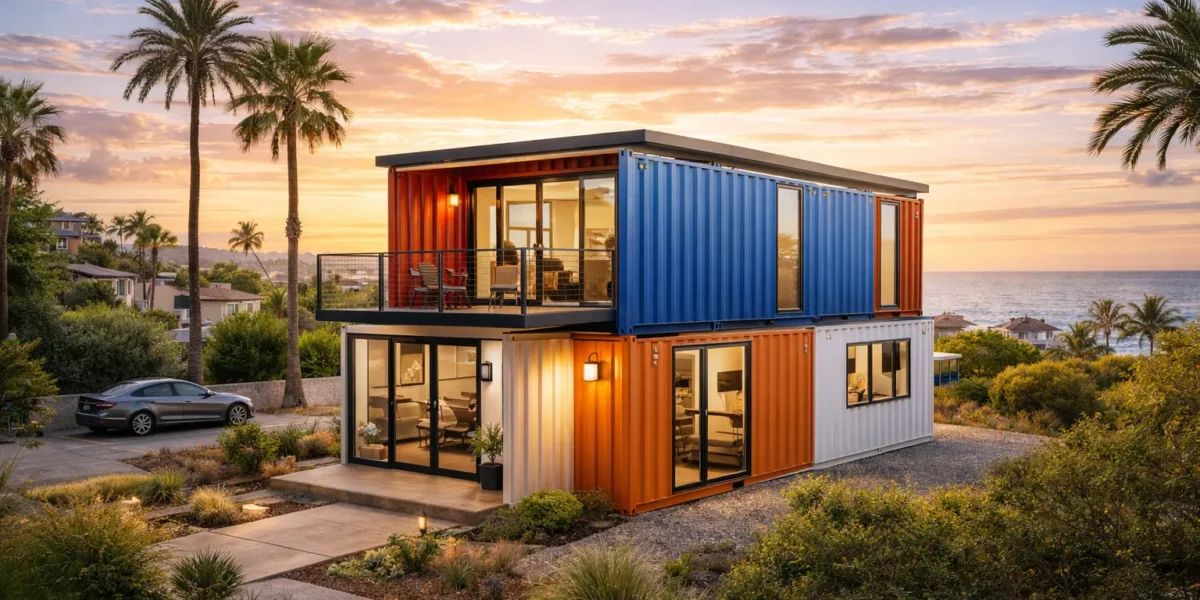
Shipping container homes are no longer an experimental trend. In 2026, they are a legitimate housing option embraced by homeowners, architects, and builders across the United States. Rising construction costs, a nationwide housing shortage, and growing interest in sustainable living have pushed container homes from novelty to mainstream faster than anyone predicted.
But building a container home is not as simple as dropping a conex box on your property and moving in. There are permits to pull, building codes to meet, foundations to pour, and design decisions that directly affect whether your container home is a comfortable living space or an expensive metal box that gets too hot in summer and too cold in winter.
This guide walks you through everything — real costs, real permit requirements, and the practical truths about container home construction in America right now.
What Does A Shipping Container Home Actually Cost?
The total cost of a container home varies enormously depending on size, complexity, location, and finishes. Here is a realistic breakdown for 2026:
The container itself — $4,500 to $7,000 per unit. For a home build, you want one trip or high-quality cargo worthy containers. Most single-container homes use one 40ft high cube unit. Multi-container homes use two to four units. Budget $5,500 for a single 40ft high cube one trip container.
Foundation — $3,000 to $15,000. Options range from concrete pier footings at $3,000 to $5,000 up to a full concrete slab foundation at $8,000 to $15,000. The right choice depends on your soil, local codes, and whether the home is permanent or semi-permanent.
Insulation — $3,000 to $8,000. This is the single most important investment in a container home. Without proper insulation, a steel box becomes an oven in summer and a freezer in winter. Closed-cell spray foam is the industry standard for containers at roughly $2 per square foot, providing both thermal insulation and a moisture barrier in one application.
Interior build-out — $15,000 to $50,000+. This includes framing, drywall or wall paneling, flooring, a kitchen, a bathroom, plumbing, electrical wiring, lighting, cabinetry, and fixtures. A basic studio finish runs $15,000 to $25,000. A fully finished home with quality appliances and custom finishes starts at $35,000 and can easily exceed $50,000.
Exterior work — $2,000 to $10,000. This covers exterior paint or cladding, a roof system (many builders add a pitched roof over the container for better drainage and aesthetics), decking, stairs, skirting, and landscaping.
Windows and doors — $3,000 to $8,000. Cutting openings in corten steel requires professional fabrication. Each window opening costs $500 to $1,500 installed, depending on size and reinforcement. A residential entry door runs $800 to $2,000 including the steel frame modification.
HVAC system — $2,500 to $6,000. A mini-split heat pump is the most popular HVAC choice for container homes — efficient, compact, and capable of both heating and cooling. A single-zone mini-split handles a one-container home. Multi-container layouts may need two or three zones.
Permits, engineering, and plans — $2,000 to $8,000. Architectural drawings, structural engineering stamps, permit applications, and inspections add up. Some jurisdictions require full residential construction drawings before issuing a permit.
Total realistic cost range:
| Home Type | Containers Used | Total Cost Range |
|---|---|---|
| Basic studio / tiny home | 1 × 40ft HC | $35,000 – $55,000 |
| One-bedroom home | 1–2 × 40ft HC | $55,000 – $90,000 |
| Two-bedroom home | 2–3 × 40ft HC | $80,000 – $130,000 |
| Large family home | 3–4+ × 40ft HC | $120,000 – $200,000+ |
These numbers assume you hire professionals for structural work, plumbing, and electrical. DIY builders who handle their own interior finishing can save 20 to 40 percent on build-out costs, but structural modifications, foundation work, and utility connections should always be done by licensed contractors.
Permits — What You Need Before You Start
This is where most first-time container home builders make their biggest mistake. They buy the container first and ask about permits later — only to discover their county does not allow it, or the permitting process takes six months, or the required setbacks make their lot too small.
Always check with your local building department before purchasing a container for a home build.
Permit requirements vary dramatically across the United States — not just state by state, but county by county and even city by city. Here is the general landscape:
States that are generally container-home friendly include Texas, Florida, Tennessee, Georgia, North Carolina, Arizona, Colorado, Oregon, and California. These states have approved container home permits in multiple jurisdictions and have builders with established track records. Texas in particular is one of the most popular states for container homes because many rural counties have minimal building code enforcement.
States with stricter requirements include New York, New Jersey, Illinois, and parts of the upper Midwest, where older building codes and strict zoning ordinances make container homes more difficult to permit — not impossible, but more expensive and time-consuming.
The specific permits you will typically need:
Building permit — required in virtually all jurisdictions for a permanent residential structure. You will need to submit construction drawings, a site plan, a foundation plan, and often a structural engineering report. The building department will review your plans and issue the permit before construction can begin.
Zoning approval — your lot must be zoned for residential use, and your container home must meet setback requirements (minimum distance from property lines), height limits, and lot coverage maximums. Some zoning codes have minimum square footage requirements that a single-container home may not meet.
Electrical permit — required for any permanent wiring, outlets, lighting, and panel installation. Must be done by a licensed electrician and inspected before the walls are closed up.
Plumbing permit — required for any water supply lines, drain lines, and sewer or septic connections. Also requires a licensed plumber and inspection.
Septic or sewer connection permit — if your lot is not connected to municipal sewer, you will need a septic system permit, which includes a soil percolation test and health department approval.
Building Codes You Must Meet
A shipping container home in the United States must meet the same building codes as any traditional stick-built house. The most widely adopted code is the International Residential Code (IRC), which most states have adopted in full or with state-specific amendments.
Key code requirements that affect container homes:
Minimum ceiling height — the IRC requires a minimum of 7 feet in habitable rooms and hallways. A standard 40ft container has an interior height of 7 feet 10 inches, which leaves very little room after adding floor insulation, subfloor, and ceiling insulation. This is exactly why the 40ft High Cube is strongly recommended for home builds — its 8 foot 10 inch interior height gives you comfortable clearance even after a full insulation and finishing package.
Egress windows — every bedroom must have at least one window large enough to serve as an emergency exit. The IRC requires a minimum opening of 5.7 square feet, with a minimum width of 20 inches and minimum height of 24 inches. Plan your window placements during the design phase, not after the container is on-site.
Structural integrity — cutting openings in a shipping container weakens its structural frame. Every window and door opening requires steel reinforcement — typically a welded header beam above the opening and support posts on each side. A structural engineer must calculate these reinforcements and stamp the drawings for your permit application.
Fire safety — smoke detectors are required in every bedroom and on every level. Carbon monoxide detectors are required if the home has any fuel-burning appliances or an attached garage. Some jurisdictions require fire-rated wall assemblies between living spaces and utility areas.
Insulation R-values — the required insulation levels depend on your climate zone. The IRC divides the United States into eight climate zones, each with different R-value requirements for walls, roofs, and floors. In Zone 4 (including cities like New York, Philadelphia, and Denver), walls require a minimum of R-20 and roofs require R-49. Your insulation plan must meet or exceed these values to pass inspection.
Plumbing and electrical — all plumbing and electrical work must comply with the International Plumbing Code (IPC) and National Electrical Code (NEC) respectively. There are no shortcuts or exceptions for container homes — the same standards apply as for any residential building.
Common Mistakes To Avoid
Buying the wrong container grade. For a home build, always use one trip or high-quality cargo worthy containers. Used WWT containers with heavy rust, welded patches, or warped panels create problems during modification — uneven surfaces make insulation difficult, and patched areas may not hold window or door frames properly.
Skipping the structural engineer. Every opening you cut in a container removes steel that contributes to its structural strength. Without proper reinforcement calculated by an engineer, the container can twist, bow, or even collapse under load. Engineering fees of $1,500 to $3,000 are a non-negotiable cost of doing this right.
Underestimating insulation costs. The number one complaint from container home owners who cut corners is temperature. Bare steel conducts heat and cold with brutal efficiency. Spray foam insulation on all interior surfaces — walls, ceiling, and floor — is the minimum standard. Do not skip the floor insulation, especially in cold climates.
Ignoring condensation. Steel containers sweat. When warm interior air meets cold steel walls, condensation forms and drips. This leads to mold, rust, and damage to interior finishes. Closed-cell spray foam solves this by creating an airtight vapor barrier directly on the steel. Open-cell foam or fiberglass batts leave air gaps where condensation still occurs.
Not budgeting for site work. The container is just one piece of the puzzle. Site grading, foundation construction, utility trenching, driveway access, and landscaping can easily add $10,000 to $25,000 to your total project cost depending on the condition of your lot.
Is A Container Home Worth It In 2026?
At $35,000 to $130,000 for a finished home, container construction remains significantly cheaper than traditional stick-built housing, which averages $150 to $250 per square foot in most U.S. markets. A 640-square-foot two-container home at $90,000 works out to roughly $140 per square foot — competitive with modular homes and substantially cheaper than conventional construction in high-cost markets.
Container homes also build faster. A single-container studio can be completed in 8 to 12 weeks from foundation pour to move-in. A two-container home typically takes 12 to 20 weeks. Traditional construction for the same square footage takes 6 to 12 months.
The sustainability angle is real too. Repurposing a 5,000-pound steel container keeps it out of the scrap yard and avoids the lumber, concrete, and material waste of a conventional build.
For the right buyer — someone who values affordability, speed, sustainability, and is willing to navigate the permitting process — a shipping container home in 2026 is absolutely worth it.
Thinking about building a container home? Browse our one trip and high cube containers at ConexBoxUSA.com/shop or call +1 (979) 365-0023 for expert advice on choosing the right container for your build.
